Every day, millions of people across India face the same question: how do I get my clothes properly cleaned without wasting time, ruining fabric, or spending more than necessary? Whether you live in a compact apartment in Mumbai, a sprawling home in Delhi, or a student hostel in Pune, laundry is one of the most consistent and unavoidable chores of daily life. And while most people are familiar with the idea of laundry services in general, very few actually understand the difference between the various types available to them.
Understanding the types of laundry services is not just an academic exercise. It is genuinely useful knowledge that helps you make smarter decisions. When you know the difference between wash-and-fold, dry cleaning, self-service laundromats, and on-demand laundry pickup services, you are in a much better position to choose the right option for each situation. You start avoiding expensive mistakes, like sending a delicate silk saree to a regular wash service, or wasting your Sunday at a coin laundry when there is a professional pickup service available nearby.
India's laundry industry has undergone a dramatic transformation in the past decade. The market, which was once dominated by local dhobis and neighbourhood ironing shops, has expanded significantly to include technologically advanced platforms, app-based laundry services, and professional garment care providers. According to recent industry estimates, India's organised laundry and dry-cleaning market is valued at over INR 1,500 crore and is expected to grow at a compound annual growth rate of over 25% through 2030. This growth is being fuelled by rapid urbanisation, rising disposable incomes, shrinking household time, and growing awareness of professional fabric care.
Yet despite this growth, a large portion of Indian consumers still does not fully understand what type of laundry service they actually need. This blog breaks that down completely. It explains the four primary types of laundry services, what each one involves, when to use it, how it works in the Indian context, what it typically costs, and which fabrics or garment types are best suited for each. By the end, you will have a complete picture of the laundry landscape and the knowledge to make the best choices for your clothes, your time, and your budget.
Why Knowing the Different Types of Laundry Services Actually Matters
Before diving into the specifics, it is worth pausing to understand why this knowledge is important in the first place. Many people think laundry is simple: you put clothes in, they come out clean. But professional fabric care is far more nuanced than that, and choosing the wrong service can lead to serious consequences.
Sending the wrong garment to the wrong service can cause irreversible damage. A dry-clean-only fabric sent to a regular wash machine can shrink, bleed colour, or lose its shape permanently. A silk blouse thrown into a wash-and-fold pile can be destroyed in a single cycle. Wool jackets, embroidered ethnic wear, heavily starched shirts, and delicate linens all require specific treatment. Without knowing which service offers which kind of treatment, you are essentially guessing, and guessing with your favourite or most expensive clothes is a costly habit.
Beyond garment protection, there is also the matter of convenience and value for money. Different laundry services carry different price points and turnaround times. If you need fresh clothes by tomorrow morning, a drop-off dry cleaner may not serve you. If you have a large volume of everyday cottons, a premium dry-cleaning service would be unnecessarily expensive and slow. Knowing your options helps you match the right solution to the right need at the right moment.
In the Indian context specifically, these distinctions matter even more because of the enormous diversity in the types of clothes people own. From everyday cotton kurtas and denim jeans to Banarasi silk sarees, woollen shawls, embroidered sherwanis, and high-performance sportswear, the average Indian wardrobe contains garments that span an incredibly wide range of fabric types and care requirements. A one-size-fits-all approach to laundry simply does not work here.
The Growing Demand for Professional Laundry in Indian Cities
India's urban landscape is changing fast. Cities like Bengaluru, Hyderabad, Chennai, Kolkata, Delhi, and Mumbai are seeing rapid growth in nuclear families, working couples, and single professionals. These demographics share a common challenge: they have less time and greater need for outsourcing domestic tasks. Laundry, which is both time-consuming and physically tiring, is one of the first things people look to delegate.
This is reflected in the data. A 2024 consumer survey conducted across ten major Indian cities found that over 64% of urban working professionals outsource at least part of their laundry needs. Among millennials aged 25 to 35, that figure rose to nearly 78%. The preference is clearly shifting away from in-home washing toward professional services, particularly those that offer home pickup and delivery.
The pandemic also played an unexpected role in accelerating this trend. During the COVID-19 lockdowns, many households either could not access their regular dhobis or felt uncomfortable with the hygiene standards of traditional laundry. This drove a significant wave of adoption toward app-based and organised laundry platforms that offered contactless service and standardised hygiene protocols.
Common Misconceptions About Laundry Services in India
There are several widespread misconceptions that prevent people from using professional laundry services effectively. One of the most common is the belief that all laundry services are essentially the same. This leads people to either overpay for services they do not need or underpay and damage their garments.
Another common misconception is that dry cleaning involves water. In fact, the word "dry" in dry cleaning refers specifically to the absence of water. The process uses chemical solvents to dissolve and remove stains and soiling without exposing the garment to water, which can cause damage in water-sensitive fabrics. Many people in India are surprised to learn this.
There is also a persistent belief that professional laundry services are only for wealthy people or for special occasions. While this may have been true a decade ago, the emergence of affordable, app-based services has dramatically democratised access to professional laundry care. Today, many quality services in Indian cities charge as little as INR 50 to INR 100 per kilogram for basic wash-and-fold, making them genuinely competitive with the cost of home washing when you factor in time, effort, water, electricity, and detergent.
The Four Main Types of Laundry Services Explained in Detail
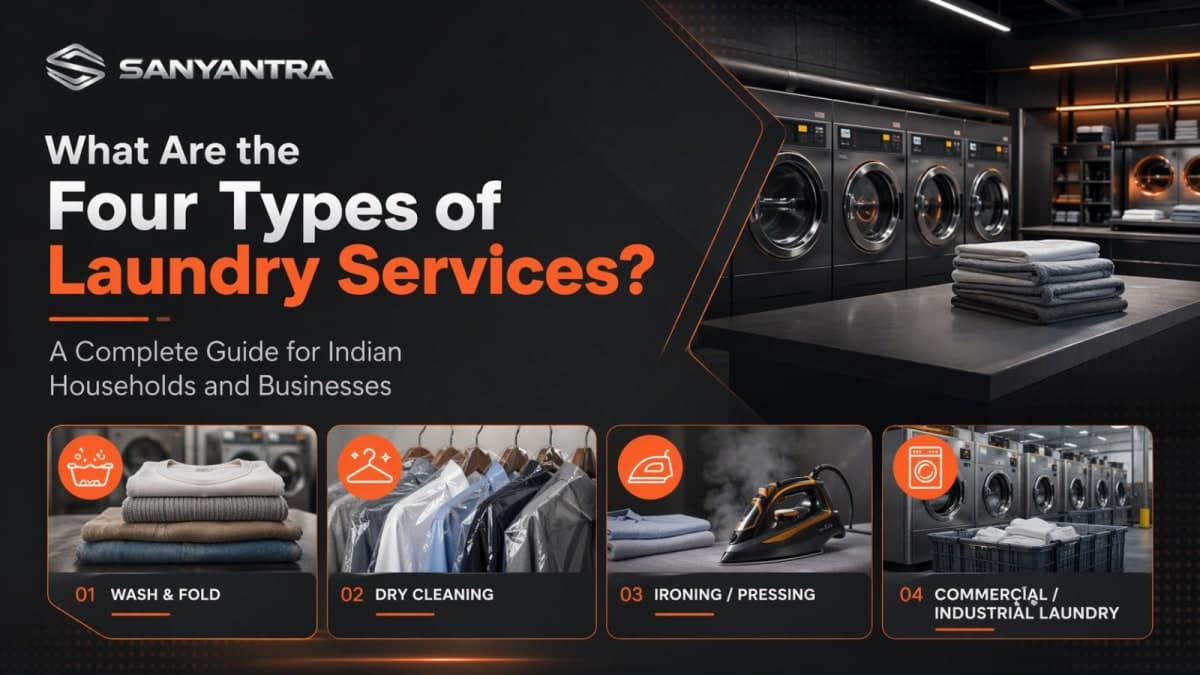
Now we arrive at the heart of the matter. There are four primary types of laundry services that exist in the professional laundry industry. These are wash-and-fold (also known as laundry by weight or regular wash), dry cleaning, self-service laundry or coin laundry, and on-demand or pickup-and-delivery laundry services. Each serves a different purpose, works on different garment types, and suits different lifestyles and budgets.
It is important to note that many modern laundry businesses offer a combination of these services under one roof or one app. But understanding each type individually helps you evaluate your options more clearly and make informed requests when you use any provider.
Type 1 — Wash and Fold: The Most Common Everyday Laundry Service
Wash and fold, also called wet wash or laundry by weight in India, is the most widely used laundry service type. It is the modern, organised equivalent of what a traditional dhobi has always provided: you give someone your clothes, they wash them, dry them, fold them, and return them. The difference is that professional wash-and-fold services use industrial-grade washing machines, controlled water temperatures, appropriate detergents for different fabric types, and hygienic drying environments.
In this service, clothes are typically accepted by weight rather than by piece. The standard pricing in Indian cities ranges from approximately INR 50 to INR 120 per kilogram, depending on the city, the service tier, and whether delivery is included. For a family of three generating roughly 5 to 7 kilograms of laundry per week, this translates to a weekly cost of around INR 300 to INR 700, which most urban families find reasonable and significantly more convenient than home washing.
The wash-and-fold service typically handles a wide range of everyday garments including cotton T-shirts, jeans, trousers, casual kurtas, bed linens, towels, children's clothes, socks, undergarments, and regular office wear. The key characteristic of this service type is that garments are washed using water, detergent, and mechanical agitation. This makes it unsuitable for fabrics that are water-sensitive, prone to shrinkage, or labelled as dry-clean only.
What Happens During a Wash-and-Fold Service
When you hand over your laundry to a wash-and-fold service, the process typically begins with sorting. Clothes are sorted by colour (whites, lights, and darks), by fabric type, and sometimes by soil level. This sorting step is critical for preventing colour bleeding and ensuring that each batch is washed at the appropriate temperature and with the right settings.
After sorting, clothes are loaded into industrial washing machines. These machines are significantly more powerful and capable than household machines. They use precise water temperatures—typically cold wash for darks and brights, warm wash for cottons, and hot wash for heavily soiled items or white linens. The detergent used is usually commercial-grade and chosen based on the fabric type and garment colour.
Once washed, clothes are dried either in industrial dryers or through air drying, depending on the fabric. Delicate fabrics and stretchy materials are typically air-dried to prevent heat damage and shrinkage. Finally, clothes are folded or hung and packaged before being returned to the customer.
Best Garments for Wash-and-Fold Services
Not every garment belongs in a wash-and-fold cycle. Knowing what works best with this service helps you avoid damage and get the most value.
Cotton clothing: Everyday cotton T-shirts, salwar suits, kurtas, and casual trousers are ideal for wet wash. Cotton tolerates water and mild agitation well, and it comes out clean and refreshed without requiring special treatment.
Denim and heavy fabrics: Jeans, denim jackets, and heavy cotton trousers can be safely handled in a wash-and-fold service. Cold water washing is recommended to prevent fading, and a reputable provider will follow this protocol automatically.
Bed linens and towels: Sheets, pillowcases, duvet covers, and bathroom towels are among the most common items sent for wash-and-fold. They are bulky, difficult to wash at home, and benefit enormously from the powerful cleaning action of industrial machines.
Children's clothing: Kids' clothes accumulate dirt, food stains, and general grime quickly. Wash-and-fold is perfect for managing large volumes of small garments efficiently.
Sports and gym wear: Synthetic activewear made of polyester or nylon can generally be handled in a wash-and-fold service, provided the temperature is kept low and harsh detergents are avoided.
What to Avoid Sending to Wash-and-Fold
There are certain garments that should never go into a standard wash-and-fold cycle. Sending these without clear instructions — or better yet, sending them to a specialised dry-cleaning or delicate-care service — is essential for protecting them.
Silk garments: Silk is one of the most sensitive fabrics and reacts poorly to water, mechanical agitation, and high temperatures. Even a single wash in a machine can cause silk to lose its sheen, shrink, or develop permanent water stains.
Embroidered or heavily embellished clothing: Indian ethnic wear like sherwanis, heavily embroidered kurtis, or bridal lehengas often feature delicate threadwork, mirror work, sequins, or hand-applied decorations that can be dislodged or damaged in a machine wash.
Woollen garments: Pure wool sweaters, shawls, and jackets require special care. Standard machine washing causes wool to felt and shrink significantly.
Dry-clean only fabrics: Always check the care label. If it says dry clean only, honour that instruction. The label is not a suggestion; it is the manufacturer's instruction based on what the fabric can safely withstand.
Pricing Guide for Wash-and-Fold in Major Indian Cities
Understanding approximate costs helps you plan your laundry budget effectively. While prices vary between providers, the following reflects general market rates as of 2025–2026:
Mumbai: INR 70–110 per kilogram
Delhi NCR: INR 60–100 per kilogram
Bengaluru: INR 65–105 per kilogram
Chennai: INR 55–90 per kilogram
Hyderabad: INR 60–95 per kilogram
Pune: INR 60–100 per kilogram
Kolkata: INR 50–85 per kilogram
Premium platforms that offer guaranteed sorting, fragrance-free detergents, allergen-free options, or eco-friendly washing typically charge at the higher end of these ranges. Economy services or local dhobi-style operators tend to fall at the lower end.
Type 2 — Dry Cleaning: Professional Care for Delicate and Special Garments
Dry cleaning is the most misunderstood of the four laundry service types, yet it is arguably the most important one to understand correctly. The term "dry cleaning" can be misleading because the process is not entirely dry — it does use liquid solvent — but it does not use water, which is the critical distinction. The absence of water is precisely what makes dry cleaning safe and effective for garments that cannot withstand water exposure.
The dry-cleaning process works by immersing garments in a chemical solvent that dissolves oil-based stains, body oils, dirt, and grime without causing the garment to swell, shrink, or lose its structure. The most commonly used solvent in traditional dry cleaning is perchloroethylene, commonly called perc. However, due to growing concerns about its environmental and health impact, many modern dry cleaners — particularly in Indian cities — have shifted to greener alternatives such as liquid CO₂ cleaning, wet cleaning with specialised equipment, or hydrocarbon solvents.
Dry cleaning is not just about cleaning; it is also about garment restoration and preservation. A skilled dry cleaner does far more than run clothes through a machine. They inspect each garment individually, identify specific stains, pre-treat those stains with appropriate spot-cleaning agents, process the garment through the solvent cycle, and then carefully finish it — whether that means pressing, steaming, reshaping, or re-lining — before packaging it for return.
What Types of Garments Require Dry Cleaning
Dry cleaning is specifically designed for garments that are too delicate, structured, or expensive to risk in water-based washing. In the Indian context, this category is especially large given the richness and complexity of traditional Indian textiles.
Silk sarees and salwar suits: Pure silk — whether Kanjivaram, Banarasi, Mysore silk, or Patola — is extremely vulnerable to water. Even a small splash of water can leave a permanent mark. Dry cleaning is the only safe professional method for cleaning silk garments, and it preserves the lustre, texture, and colour vibrancy that make these fabrics so valuable.
Woollen and cashmere garments: Wool and cashmere require the gentlest possible treatment. Water causes the microscopic scales of wool fibres to interlock, leading to felting and irreversible shrinkage. Dry cleaning bypasses this problem entirely. A well-maintained woollen blazer or cashmere sweater can last for decades with regular dry cleaning.
Formal and structured suits: Men's suits, blazers, and formal jackets contain internal interfacing, shoulder padding, and lining that can warp, bubble, or delaminate when exposed to water. Dry cleaning preserves the structure of tailored garments.
Designer and branded clothing: High-end Indian and international fashion labels typically carry dry-clean-only labels. This is not snobbery; it is a practical instruction based on the specific fabrics, dyes, and construction methods used.
Heavily embroidered ethnic wear: Bridal lehengas, sherwanis, zardosi-work kurtis, and heavily beaded garments all require dry cleaning to protect the embellishments and prevent colour migration between different threads.
Vintage or heirloom garments: Family heirlooms, antique textiles, and vintage clothing are too precious to risk in a machine. Professional dry cleaning with hand-finishing is the appropriate care method.
How to Identify If Your Garment Needs Dry Cleaning
Every garment that is sold commercially in India should carry a care label — a small tag sewn inside the garment near the collar or waist — that provides washing instructions using internationally standardised symbols. The dry-clean symbol is a circle. If the circle has a letter inside it (indicating the type of solvent), it is still a dry-clean instruction. If the circle has an X through it, the garment should not be dry-cleaned.
Beyond the label, there are also practical indicators. If a garment is made of silk, wool, cashmere, rayon, or a fabric blend that includes these fibres, dry cleaning is almost always the safest option. If a garment has substantial structure — like a tailored jacket, a heavily lined dress, or a stiffened blouse — dry cleaning preserves that structure better than wet washing. If a garment has intricate embroidery, beadwork, or hand-painted details, dry cleaning minimises the risk of damage during cleaning.
The Dry-Cleaning Process Step by Step
Understanding the full process helps you appreciate the skill and expertise involved in professional dry cleaning. It also explains why the service costs more than basic wash-and-fold.
The process begins with garment inspection. Every piece is examined for stains, damage, missing buttons, loose seams, and specific care requirements. This inspection is done by a trained technician, not a machine.
Next is pre-spotting, where individual stains are identified and treated with specific stain-removal agents before the main cleaning cycle. Different stains — ink, grease, wine, rust, protein-based stains — each respond to different chemicals, and a good dry cleaner knows exactly which treatment to apply.
The garment then enters the dry-cleaning machine, which tumbles it gently in a bath of solvent. The machine simultaneously cleans and extracts the solvent, leaving the garment significantly cleaner without any water exposure.
After cleaning, the garment undergoes post-spotting — a second inspection and treatment for any stains that the main cycle did not fully remove. This is followed by finishing, which may involve steam pressing, hand pressing, reshaping on forms, or re-blocking for knitwear.
Finally, the garment is inspected one last time and packaged — typically in a breathable garment bag — before being returned to the customer.
Dry Cleaning Costs in India
Dry cleaning is priced per piece rather than by weight, and the cost reflects the complexity and value of each garment.
Suit (two-piece): INR 400–900
Saree (silk): INR 300–700
Lehenga or sherwani (heavily embroidered): INR 700–2,500
Woollen overcoat or blazer: INR 400–900
Cashmere sweater: INR 300–600
Formal trousers: INR 150–300
Silk blouse: INR 200–400
In metro cities like Mumbai, Delhi, and Bengaluru, premium dry cleaners may charge at the higher end of these ranges, particularly for wedding or designer garments.
Type 3 — Self-Service Laundry (Coin Laundry / Laundromat): Flexible and Affordable
Self-service laundry, commonly known as a laundromat or coin laundry, represents a model of Coin Laundry where the customer comes to a facility equipped with commercial washing machines and dryers and operates the machines themselves. This model has been standard in Western countries for decades but is a relatively recent introduction to India.
The concept is straightforward: you bring your laundry to the laundromat, load it into one of the available machines, add detergent (which may be purchased on-site or brought from home), select your cycle, pay using coins, tokens, or a digital app, and wait for the cycle to complete. Drying is done in separate commercial dryers, and once done, you take your clean, dry laundry home.
The Rise of Laundromats in Indian Cities
Self-service laundry facilities are growing rapidly in Indian cities, particularly in areas with high concentrations of students, young professionals, and transient populations. Cities like Pune, Bengaluru, Hyderabad, and Delhi NCR have seen a noticeable uptick in laundromat openings since 2019.
The target audience for this service in India is somewhat specific. Students living in hostels or paying guest accommodations without in-room laundry facilities represent one of the primary user groups. Young professionals in studio apartments or shared housing with limited space for full-size washing machines are another. Travellers staying in budget hotels or Airbnb properties without laundry facilities also find laundromats extremely useful.
The appeal is control and flexibility. You manage your own laundry, you know exactly what goes into each machine, and you are present for the entire process. For people who are particular about how their clothes are handled, or who are concerned about mixing their clothes with strangers' laundry, the laundromat offers full visibility and control.
Advantages of Self-Service Laundry
Cost-effectiveness for small loads: If you have a relatively small batch of laundry and do not want to wait for a delivery service or pay the minimum order threshold, a laundromat is a practical and affordable option. A standard wash cycle at most Indian laundromats costs between INR 100 and INR 200, and drying adds another INR 50 to INR 100.
Speed and immediacy: Most laundromat cycles are completed within 30 to 45 minutes, and drying takes an additional 20 to 40 minutes. This makes it possible to have clean, dry laundry within about an hour and a half, which is ideal for urgent situations.
Machine quality: Commercial laundromats use high-capacity, front-loading machines that are generally more gentle on fabrics and more effective at cleaning than most basic home washing machines. The spin speeds are higher, which means clothes come out better dried and require less drying time.
Access for apartment dwellers: Many urban apartments in India lack the infrastructure for a full-size washing machine. Laundromats provide a practical solution without requiring capital investment or installation.
Limitations of Self-Service Laundry
Time commitment: Unlike drop-off or pickup services where the work is done for you, self-service requires your physical presence for the duration of the cycle. For busy professionals, spending 90 minutes at a laundromat may not always be practical.
No expert handling: Since you are doing the work yourself, there is no professional oversight of how garments are sorted, washed, or dried. If you make errors in sorting or temperature selection, the consequences are entirely yours.
Limited suitability for delicate garments: Laundromats are best for standard cottons, linens, and synthetics. Delicate fabrics that require specialised treatment still need to go to a dry cleaner or a professional laundry service.
Availability and location: While laundromats are growing in Indian cities, they are still concentrated in specific areas. If you do not have one near your home or workplace, the convenience factor diminishes significantly.
What to Expect at an Indian Laundromat
Most modern laundromats in India are well-equipped and reasonably comfortable. You can expect fully automatic front-loading washing machines of varying capacities (typically 7 kg, 9 kg, and 12 kg), coin or token-operated or app-based payment systems, commercial dryers, folding tables and seating, and sometimes vending machines for detergent pods and fabric softeners. Some premium laundromats also offer attendant-assisted service for a small additional fee.
Type 4 — On-Demand Pickup and Delivery Laundry Services: The Future of Laundry in India
The fourth and most modern type of laundry service is the on-demand pickup and delivery model, often referred to simply as doorstep laundry or app-based laundry service. This model combines the professional quality of traditional laundry and dry-cleaning services with the convenience of modern on-demand technology. You schedule a pickup through an app or website, a representative collects your laundry, it is processed at a professional facility, and it is returned to your door — typically within 24 to 72 hours.
This is arguably the fastest-growing segment of the Indian laundry industry. Driven by the explosion of smartphone usage, the growth of gig economy logistics, and the time pressures of urban life, on-demand laundry platforms have emerged as a compelling alternative to both traditional service providers and in-home washing. Companies and platforms offering this service have seen significant adoption across Tier 1 and Tier 2 Indian cities in recent years.
The beauty of this model is that it removes virtually all friction from the laundry process. You do not have to travel anywhere, carry anything, or wait at a facility. You simply pack your clothes into a bag, request a pickup at a convenient time, and receive them back clean and folded or on hangers a day or two later.
How On-Demand Laundry Services Work
The end-to-end process of a modern on-demand laundry service in India typically looks like this:
You begin by downloading the service's app or visiting their website. Most platforms allow you to register quickly using your phone number and location. You then select the type of service you need — wash and fold, dry cleaning, steam ironing, or a combination — and schedule a pickup time that suits your schedule. Many platforms offer same-day pickup with one or two-hour windows.
At the scheduled time, a pickup agent arrives at your door. Depending on the platform, you may be provided with branded laundry bags to sort your clothes in advance. At pickup, your garments are catalogued (many services photograph each garment before processing to maintain accountability) and transported to the service facility.
At the facility, clothes are processed according to the service selected. Wash-and-fold items go through an industrial wet washing process. Dry-clean items are handled by trained technicians. Steam press or ironing-only items are carefully pressed and finished. Many premium platforms use RFID tagging or barcode systems to track each garment individually throughout the process, eliminating the risk of loss or mix-up.
Once processed, your clothes are packaged and returned to you at your door. Most services allow you to track the status of your order in real time through the app, and many send SMS or app notifications at key stages.
Why On-Demand Laundry Is Growing So Fast in India
Several factors are converging to make on-demand laundry one of the most attractive domestic service sectors in India right now.
First, there is the time factor. India's urban working population is increasingly time-poor. Both partners in a household often work full-time, leaving limited hours for domestic chores. Outsourcing laundry to an on-demand service is a logical time-saving strategy.
Second, there is quality assurance. Organised on-demand platforms maintain standardised processes, quality checks, and accountability systems that are more reliable than informal local services. They also tend to use better detergents, more sophisticated equipment, and trained staff.
Third, there is convenience. The ability to schedule a pickup and delivery through an app, pay digitally, and track your order in real time represents a level of convenience that no traditional laundry model can match. For tech-savvy urban consumers, this frictionless experience is highly appealing.
Fourth, there is trust and accountability. One of the historically significant concerns about outsourcing laundry in India has been the fear of garments going missing or being damaged. Reputable on-demand platforms address this with garment-level tracking, photographic records, insurance policies, and transparent grievance redressal.
Services Typically Offered Within On-Demand Laundry Platforms
Modern on-demand platforms are not limited to basic washing. They typically offer a comprehensive menu of garment care services that can be selected individually or combined.
Wash and fold: The standard service for everyday cottons, linens, and casual wear, charged by weight.
Dry cleaning: Available for delicate and structured garments, charged per piece with garment-specific pricing.
Steam ironing and press only: For clothes that are already clean but need to be freshly pressed before use. This is particularly popular for work shirts, formal wear, and school uniforms.
Stain removal: Some platforms offer specialised stain removal as a standalone service or as an add-on, where technicians use targeted treatments for specific stain types.
Shoe and bag cleaning: Premium platforms in major cities have expanded their offerings to include leather and canvas shoe cleaning, handbag restoration, and accessory care.
Curtain and sofa cover cleaning: Household soft furnishings like curtains, sofa covers, and heavy blankets are difficult to wash at home and are increasingly being handled by on-demand platforms.
Comparing the Four Types of Laundry Services Side by Side
To summarise and clarify the key differences, here is a structured comparison of all four service types across the most important parameters.
Turnaround Time
On-demand pickup and delivery services typically offer a turnaround of 24 to 72 hours, with some offering express options within 12 to 24 hours at a premium. Dry cleaning at a standalone facility usually takes 24 to 48 hours. Wash-and-fold at a drop-off location is often completed within the same day or overnight. Self-service laundromats are the fastest, with the entire process taking approximately 60 to 90 minutes on-site.
Fabric and Garment Suitability
Wash-and-fold handles everyday cottons, linens, polyester blends, and most casual wear. Dry cleaning is essential for silk, wool, cashmere, tailored garments, embroidered ethnic wear, and all dry-clean-only fabrics. Self-service laundromats are appropriate for sturdy, water-safe fabrics in standard everyday garments. On-demand platforms typically cover all garment types by offering both wet washing and dry-cleaning options under one service.
Cost Comparison
Self-service laundromats are generally the cheapest per kilogram but require time investment. Wash-and-fold drop-off services offer very reasonable pricing with the added benefit of professional handling. On-demand services carry a modest premium over drop-off services but include the value of pickup and delivery convenience. Dry cleaning is the most expensive service type per piece, reflecting the specialised process and expertise involved.
Convenience
On-demand pickup and delivery is by far the most convenient option, requiring zero travel or wait time. Drop-off wash-and-fold is moderately convenient if a facility is located nearby. Dry cleaning requires a deliberate trip and planning. Self-service laundromats require the least delegation but the most personal time investment.
How to Choose the Right Type of Laundry Service for Your Needs
Choosing the right laundry service is not about picking the most expensive or the cheapest option. It is about matching the service type to the specific needs of your garments and your lifestyle.
Questions to Ask Before Choosing a Laundry Service
Before you select a service, run through these practical questions:
What type of fabric is the garment made of? Check the care label first. If it says dry clean only, that is your answer.
How urgently do you need the garment back? If you need it within a few hours, a self-service laundromat or a same-day drop-off wash service may be your only option.
What is the garment's value — financial or sentimental? The more valuable the garment, the more important it is to use a professional service with accountability.
How much laundry do you have? Small loads work well in a laundromat. Large household volumes are best served by a wash-and-fold or on-demand service.
How much time can you invest? If time is scarce, on-demand pickup and delivery is the smartest choice. If you have time and enjoy control, a laundromat works well.
Special Considerations for Indian Households
Indian households have some specific laundry needs that are worth addressing directly.
Indian ethnic wear — particularly silk sarees, embroidered kurtas, and bridal wear — is among the most complex laundry challenge. These garments often combine multiple fabric types, delicate embellishments, and deep dye colours that require professional dry cleaning or very careful hand washing. Never send these to a bulk wash-and-fold service without explicit sorting and handling instructions.
School uniforms, which are almost universally white or light-coloured in India, require regular washing and effective whitening. A wash-and-fold service with appropriate whitening agents or an oxygen-based whitening protocol is ideal for these.
Woollen shawls and blankets, which are commonly used across northern India during winter months, should always be dry-cleaned or sent to a professional service that specialises in woollen care. Home machine washing almost invariably results in shrinkage.
Heavy cotton or polyester bed linens, curtains, and sofa covers are best handled by an on-demand platform or a wash-and-fold service with large-capacity machines, since these items are too bulky for standard home washing.
Common Mistakes People Make When Using Laundry Services
Even with all this knowledge, it is easy to make mistakes when outsourcing your laundry. Awareness of these common errors can save you a great deal of frustration and expense.
Not Reading Care Labels Before Dropping Off
This is the single most common and costly mistake. Sending a dry-clean-only garment to a standard wash-and-fold service without flagging it can result in irreversible damage. Always check the care label, and if you are unsure, tell the service provider the fabric type and let them advise you.
Mixing Heavily Soiled Items With Regular Laundry
Heavily soiled items — such as muddy sports gear, oil-stained kitchen clothes, or pet-soiled linens — should ideally be flagged or separated when handing over your laundry. Mixing them in with regular clothes without notice can result in cross-contamination, where stains or odours transfer to otherwise clean garments during the wash cycle.
Not Noting Down What You Are Sending
A surprisingly common issue with home-based laundry outsourcing is losing track of what was sent. A missing sock is annoying; a missing designer saree is a much bigger problem. Before handing over your laundry — especially to any service provider — make a basic note of how many pieces you are sending, particularly for valuable or irreplaceable items.
Choosing Price Over Quality for Valuable Garments
It is tempting to always opt for the cheapest available service. But when it comes to valuable garments like silk sarees, tailored suits, embroidered lehengas, or branded clothing, the cost of using an inadequate service provider is far higher than the savings. For such garments, quality and accountability matter more than price.
Ignoring Stains Before Dropping Off
If a garment has a specific stain — ink, grease, wine, turmeric, blood — the best practice is to point this out to the service provider at drop-off. Pre-spotting is far more effective when the stain is fresh and when the technician knows to look for it. Old, set stains that have gone through a full wash cycle are significantly more difficult to remove.
Emerging Trends in the Indian Laundry Industry
The laundry services sector in India is not static. It is evolving rapidly, driven by technology, consumer awareness, and environmental consciousness. Understanding these trends helps you anticipate what the next generation of laundry services will look like.
Green and Eco-Friendly Laundry Practices
Environmental awareness is growing among Indian consumers, and laundry services are responding. Several forward-thinking providers are transitioning away from traditional petrochemical dry-cleaning solvents toward greener alternatives. Wet cleaning — a water-based process using biodegradable detergents and precise machine controls — can safely handle many fabrics that were previously considered dry-clean only. Liquid CO₂ cleaning is another emerging technology that uses pressurised carbon dioxide as a solvent, leaving virtually no chemical residue.
On the wet washing side, brands are increasingly offering phosphate-free, plant-based detergents as an option. Water conservation is also becoming a priority, with some facilities investing in water recycling systems that reduce their per-kilogram water consumption significantly.
Technology Integration and AI in Laundry Services
The integration of technology into laundry services goes beyond apps and online scheduling. Some leading platforms are beginning to use machine learning and artificial intelligence for garment classification and routing. Cameras and sensors can identify fabric types, stain categories, and optimal wash parameters, reducing the risk of human sorting errors.
RFID tagging for garment tracking, already standard in some premium services, is expected to become more widespread as costs decrease. This technology attaches a small RFID tag to each garment and tracks it through every stage of the cleaning process, virtually eliminating the risk of lost or misplaced items.
Subscription-Based Laundry Models
Subscription laundry plans are gaining traction in India, particularly among young professionals and nuclear families. Under these plans, customers pay a fixed monthly fee in exchange for a guaranteed volume of laundry service — for example, 20 kilograms of wash-and-fold per month, four dry-clean pieces per month, and unlimited steam pressing. These plans offer significant cost savings over one-time orders and encourage regular use.
Final Thoughts
Laundry may seem like a routine chore, but once you understand the four types of laundry services — wash and fold, dry cleaning, self-service laundromats, and on-demand pickup and delivery — it transforms into a system that actually works for you. The right knowledge helps you protect your clothes, save money, and avoid the kind of damage that comes from sending the wrong garment to the wrong service.
If you are managing everyday cottons, bed linens, and casual wear, wash and fold is your most practical and cost-effective option. If your wardrobe includes silk sarees, woollen jackets, tailored suits, or heavily embroidered ethnic wear, dry cleaning is not optional — it is the only responsible choice. If you prefer full control over your laundry and have a facility nearby, a self-service laundromat gives you speed and flexibility. And if time is your most valuable resource, an on-demand pickup and delivery service is the smartest way to handle laundry without disrupting your day.
India's fabric diversity is extraordinary. From everyday cotton kurtas worn in the streets of Jaipur to heirloom Banarasi silk sarees passed down through generations, each garment deserves care that matches its nature. Understanding laundry services is not just useful knowledge — in a country where fabrics are this varied and this valuable, it is genuinely essential.
Do not wait for a favourite garment to be ruined before you start paying attention. Check care labels before every wash, sort your clothes deliberately, and invest in professional services for pieces that truly deserve expert handling. The life of your wardrobe depends on the decisions you make today.
Thinking About Starting a Laundry Business? Sanyantra Can Help You Build It Right
If reading this blog has sparked more than just curiosity — if you are someone who is seriously considering starting a professional laundry or dry-cleaning business in India — then Sanyantra is exactly the kind of partner you need to speak with.
Sanyantra Automation Private Limited, headquartered in Sector 63, Noida, Uttar Pradesh, is one of India's leading commercial and industrial laundry solutions providers. They are not a laundry service themselves — they are the backbone behind laundry businesses across India. With over 10 years of excellence, a presence across 26+ states, and 500+ successful projects completed, Sanyantra has established itself as a trusted name for anyone looking to set up, upgrade, or scale a professional laundry operation.
What makes Sanyantra genuinely valuable is the breadth of what they offer. They are authorised channel partners and dealers for some of the world's most respected laundry equipment brands, including Domus, Speed Queen, LG Commercial Laundry, Unisec, Stirmatic, and Omnisec. Whether you need high-capacity washer-extractors, industrial tumble dryers, flatwork ironers, perc or hydrocarbon dry-cleaning machines, steam press finishing equipment, shoe cleaning machines, or garment packaging systems — Sanyantra provides the right machinery for your specific business model and scale.
Beyond equipment supply, Sanyantra offers end-to-end laundry business consultancy services that are genuinely comprehensive. Their consulting covers every stage of building a laundry business from the ground up:
Business feasibility and planning: Market research, ROI estimation, investment analysis, and identifying the right business model for your target location and customer base.
Machinery and equipment selection: Guidance on choosing the most energy-efficient, cost-effective machines based on your service offerings — whether you are setting up a retail laundry, a coin laundromat, a hotel laundry, a hospital laundry, or a large commercial operation.
Chemicals and cleaning solutions: Connections with trusted Indian and international suppliers for high-quality, fabric-friendly detergents, stain removers, and softeners that deliver consistent results.
Store fabrication and layout design: Functional, efficient, and customer-friendly space design with optimised workflow, machine placement, and interior branding for maximum impact.
Brand identity, marketing, and customer acquisition: Help with naming, logo design, digital marketing strategies, social media campaigns, and customer loyalty programs that set your business apart in a competitive market.
Laundry software and mobile app integration: POS systems, CRM tools, order management apps, pickup and delivery scheduling, and performance tracking dashboards tailored for laundry businesses.
Staff training and SOP development: Customised training programs and Standard Operating Procedures that ensure consistent quality, hygiene, and professionalism across your entire team.
Growth mentorship and franchise support: For those who want to scale from a single outlet to a multi-city chain, Sanyantra provides proven frameworks, franchise model development, and ongoing mentorship.
Sanyantra's consulting is led by a seasoned industry professional with 15+ years of hands-on experience in the laundry and dry-cleaning business, who has personally mentored 50+ entrepreneurs and helped generate over INR 40 crore in revenue for laundry businesses across India. Their approach is not generic advice — it is tailored, data-driven, and rooted in the realities of running a profitable laundry operation in the Indian market.
They serve a wide range of industry verticals, including retail laundry, industrial laundry, hotel and hospitality laundry, hospital and healthcare laundry, campus laundry for schools and colleges, and commercial laundry for offices and coworking spaces.
Ready to Launch or Upgrade Your Laundry Business? Here Is Your Next Step
You now have a complete understanding of the four types of laundry services and how the professional laundry industry works in India. If you are a business owner, entrepreneur, hotel operator, hospital administrator, or someone with a genuine interest in entering the laundry industry, the next move is clear.
Visit www.sanyantra.com to explore their full range of commercial and industrial laundry machines, accessories, and business solutions. Whether you are starting from zero and need guidance on setting up your first laundry outlet, or you are an established operator looking to upgrade your equipment or expand to new locations, Sanyantra has the expertise, the machines, and the mentorship to make it happen.
You can also reach their team directly at 8796958889 or write to them at info@sanyantra.com. Their office is located at H-187, Sector 63, Noida, Uttar Pradesh — and their network spans 26+ states across India, so no matter where your business is based, they can support you.
The laundry industry in India is growing fast. The market is ready, the demand is real, and the opportunity is significant. What separates a successful laundry business from one that struggles is not just hard work — it is the right equipment, the right setup, and the right guidance from day one. That is exactly what Sanyantra delivers.
Get your free consultation today at sanyantra and take the first step toward building a profitable, professional laundry business in India.